Structural drying works because forcing dry air across wet materials speeds evaporation while a dehumidifier captures the released moisture before it re-soaks the room. Low-grain refrigerant (LGR) dehumidifiers are…
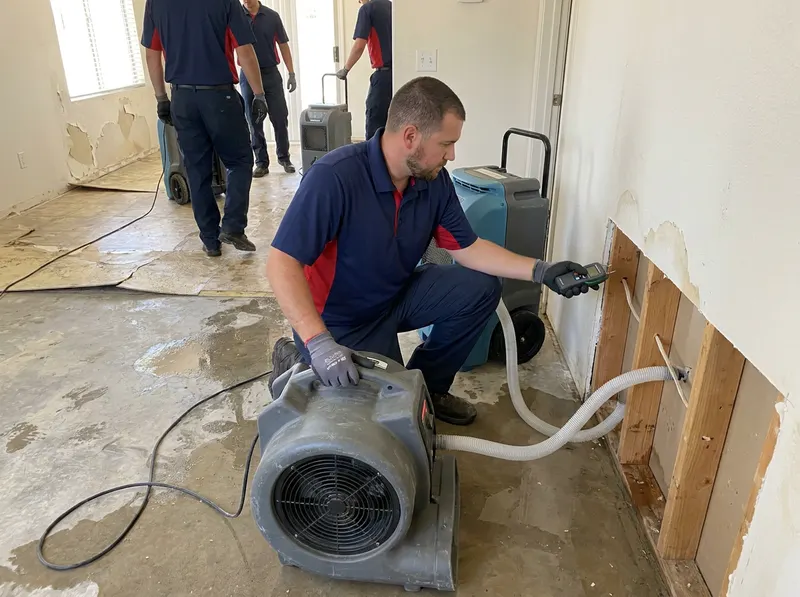
Structural drying works because forcing dry air across wet materials speeds evaporation while a dehumidifier captures the released moisture before it re-soaks the room. Low-grain refrigerant (LGR) dehumidifiers are standard on Mesa water losses because they keep pulling water even as the air dries out, which matters in an interior room with the AC running. Air movers are positioned to sweep the wet surface at an angle, and the count scales with the wet area: a single flooded bathroom in Dobson Ranch may need 2 to 4 air movers and one dehumidifier, while a whole-floor loss in Eastmark or Alta Mesa can call for a dozen or more.
The sequence is straightforward. First a technician maps moisture with a pin or non-invasive meter to mark how far water traveled behind baseboards and up drywall. Second, wet trim and a few inches of drywall may be removed so the wall cavity can breathe and dry from the inside. Third, air movers and dehumidifiers run continuously while readings are logged daily against the dry-standard target set by the unaffected materials in the same home. Fourth, drying stops only when framing and subfloor read within a few points of that baseline, not on a fixed calendar day.
Drying fits when the structure is wet but salvageable, which describes most clean-water losses caught within a day or two. If materials sat wet for several days, or the water was sewage, some drywall and flooring will be removed and replaced rather than dried, and drying then focuses on the framing left behind. Mesa's dry climate helps: outdoor humidity is often low, so a well-sealed home dries faster here than in a coastal city, but that same dry air can mask a wet wall cavity that still reads high on a meter. Tile-heavy Mesa floors add a wrinkle because water wicks under tile and into the subfloor through grout lines, so a floor that feels dry on top can still hold moisture underneath in homes across Superstition Springs, Red Mountain Ranch, and Sunland Village.
Daily monitoring is the part homeowners underestimate. Readings from a Mountain Bridge or Augusta Ranch job are recorded to show an insurance adjuster that materials actually reached dry standard, which protects a later claim if mold appears. Equipment left running an extra day is far cheaper than reopening a wall a month later. If a leaking water heater or slab leak in Lehi or Las Sendas soaked an interior wall, the cavity behind it is often the last thing to dry and the first place mold starts, so it gets its own targeted airflow rather than relying on room air alone.
Every job gets a firm, written price after a free on-site visit.
Tell us about your structural drying & dehumidification job in Mesa and we'll send a clear, written quote, usually the same day.
 Water Damage Restoration Mesa