Category-3 water is defined by contamination, not volume. A single overflowing toilet in a Dobson Ranch hallway bath and a main-line backup flooding a Sunland Village slab are both Category 3, because both carry…
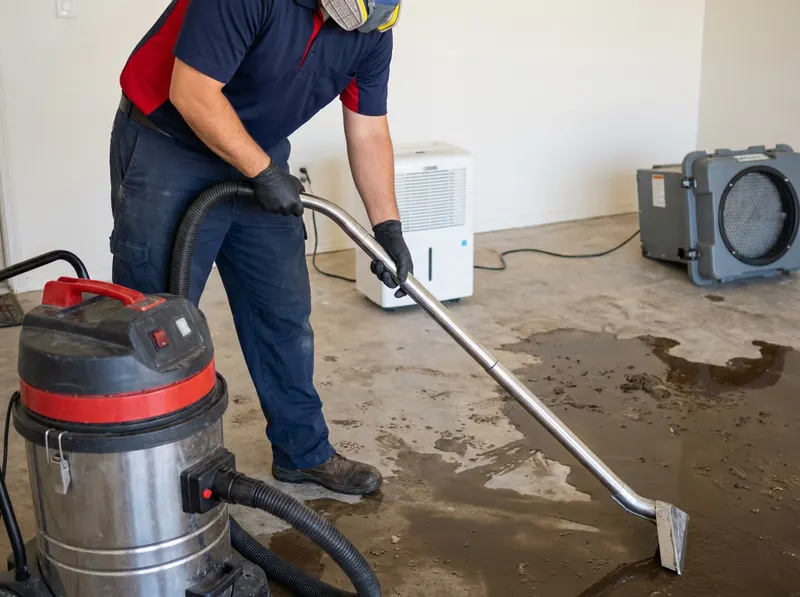
Category-3 water is defined by contamination, not volume. A single overflowing toilet in a Dobson Ranch hallway bath and a main-line backup flooding a Sunland Village slab are both Category 3, because both carry sewage-borne pathogens. Under IICRC S500, porous materials saturated with Category-3 water, carpet, carpet pad, and the lower courses of drywall and insulation, are removed rather than dried in place, because disinfectant cannot reliably reach pathogens inside those materials.
The process runs in a fixed order. First, plastic containment is built around the affected zone to stop cross-contamination into clean rooms. Second, contaminated water is extracted with truck-mounted or portable units. Third, unsalvageable porous materials are cut out and bagged. Fourth, hard surfaces are HEPA-vacuumed and treated with an EPA-registered antimicrobial. Fifth, air movers and dehumidifiers dry the structure, with moisture readings logged at each visit until framing and slab return to a dry standard. This sequence is what separates true Category-3 remediation from a simple water pull-out.
Decision-fit depends on the source. Clean water from a supply line or water-heater tank starts as Category 1 and may be dried in place if handled within roughly 24-48 hours, that is standard water extraction, not sewage cleanup. Sewage, toilet-trap-and-beyond overflow, and outside floodwater are Category 3 from the first minute and require the full disinfection protocol above; there is no shortcut version. Older Lehi and Alta Mesa homes on aging cast-iron and clay laterals see more main-line backups, while newer Eastmark and Mountain Bridge builds more often see appliance and toilet-supply failures. Homes on slab foundations across Red Mountain Ranch, Las Sendas, Augusta Ranch, and Superstition Springs get contaminated water wicking into wall cavities and under cabinet toe-kicks, which is why moisture mapping behind walls is part of the scope.
A sewage backup is not a job to load into a shop-vac and mop. Category-3 water requires respirators, containment, and antimicrobial handling, and disturbing it without protection spreads pathogens through the air. In the first 60 minutes, the safe steps are: stop using water fixtures that feed the backup, keep children and pets out of the affected room, shut off the circuit to any wet outlets, and photograph everything before anything is touched, those photos support both the estimate and a homeowner's insurance claim.
Every job gets a firm, written price after a free on-site visit.
Tell us about your sewage & category-3 water cleanup job in Mesa and we'll send a clear, written quote, usually the same day.
 Water Damage Restoration Mesa